
Direct Laser Interference Patterning, explained.
DLIP splits one laser beam into two or four sub-beams and overlaps them on the surface. The interference pattern is much smaller than the beam itself, with typical periods from 300 nm to 30 µm, and it is written in a single step.
Set the angle, get the period.
For two beams the structure period follows Λ = λ / (2 sin θ). Pick a wavelength from the CORE series and change the beam angle to see the fringe spacing on the surface.
Four geometries, many functions.
Line, dot and cross patterns, or hierarchical structures that combine several length scales. Each geometry changes how a surface handles water, light, friction or cells.
Lines2-beam. Wetting, friction, light control.
Dots4-beam. Anti-reflection, biocompatibility.
CrossesTwo passes rotated by 90°.
HierarchicalSeveral scales, as on a lotus leaf.
What the laser leaves behind.
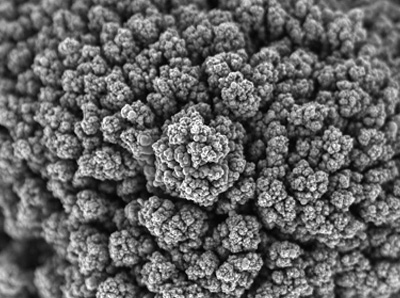
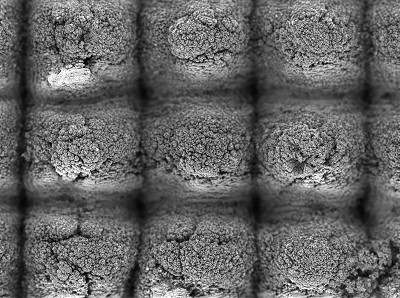
Electron micrographs of DLIP-textured surfaces. The material is only changed at the interference maxima; the minima stay untouched.
Why DLIP instead of coating or etching.
Compared with photolithography, coatings, etching or sandblasting, laser texturing is contact-free and usually needs no chemicals or clean room.
| Property | DLIP | Coating | Photolithography / etching |
|---|---|---|---|
| Process steps | One | Several | Several, with masks |
| Chemicals | Typically none | Yes | Yes |
| Clean room / vacuum | Not required | Often | Yes |
| Durability | Structure is part of the material | Can wear or peel | Part of the material |
| Large areas, 3D parts | Up to 3 m²/min, 2D and 3D | Yes | Mostly flat wafers |
Almost any material
Metals, polymers, ceramics, composites, coatings and glass.
Your laser source
Compatible with most short and ultra-short pulse lasers, burr-free with low heat input.
Your machine
Patented compact modules for CNC machines, robot arms and roll-to-roll lines, without internal optical adjustment.
Which structure does your surface need?
Our team brings more than 20 years of laser surface research from Fraunhofer IWS and TU Dresden.